Thursday, June 23, 2011

Basque Country

Basque Country is a region spanning the France/Spain border that has a culture, language, and food tradition all its own. It is considered by many to be the “culinary capital” of Spain, and we were told along the way that tapas originated in San Sebastian, a city we visited and ate in, and that the tapas there are unlike any you will find elsewhere in Spain. Much of the wealth of this area was due to the maritime prowess of its people, so the cuisine is heavily oriented toward seafood. But they are also known for some specific pastry – gateaux basques – as well as chocolates. We had some of all, naturally!

The upside of tapas – called pintxos (prounounced peen-choss) – besides how delicious they are!! – is that you can try so many different types without getting too stuffed. The downside for a blog is that there is so much to describe! So, I will use the caption of each photo for extra detail. 
 

Chorizo sausage, tortilla (potato omlette), marinated artichoke heart with olives,
puff pastry with crab topping, crostini with blue cheese and walnuts
.

Crostini with onion jam and a round of grilled soft cheese.


Besides seafood, the cuisine uses a lot of peppers – both red and green – but we didn’t have anything that we considered spicy, and the food is not known to be spicy, as well-seasoned as it is. Onions, garlic, and tomatoes also figure heavily into the dishes, along with all types of seafood: mussels, white fishes of all types including a lot of cod (bacalao, sometimes salt cod), mussels, shrimp, clams, octopus, squid, crab, and on and on to things I can’t even hope to identify. 

Live, squiggly snails in a mesh sack at the market.

It's hard to tell from this photo how absoltuely enormous the bell peppers
were -many were well over 10" long.


The chocolates – filled, and truffles, were all very good. The pastries were of a more dense texture, sort of a cross between a pate brisee and a cookie. The Gateau Basque is the consistence of a cookie, but more the texture of a shortbread pie crust. Sometimes it has a soft “cream” filling, otherwise it is filled with cherry jam. We preferred the jam versions because the “cream” filling while softer than the baked exterior, is still mostly the same taste and texture both inside and outside. This was the same for the house specialty “Pastel Vasco” we tried from a local bakery… it was shaped like a tart, but had a soft pie-crust texture with a dense, buttery filling. All of the ones we tried were very good, but they aren’t what I will go back for. They are sweetened, but aren’t too sweet, yet otherwise don’t have much flavor profile. I think the finesse is in the texture, which is too soft to be a cookie, but too firm and crispy to be cake. It’s difficult to describe, so if you have a chance to try one, I highly recommend you do!

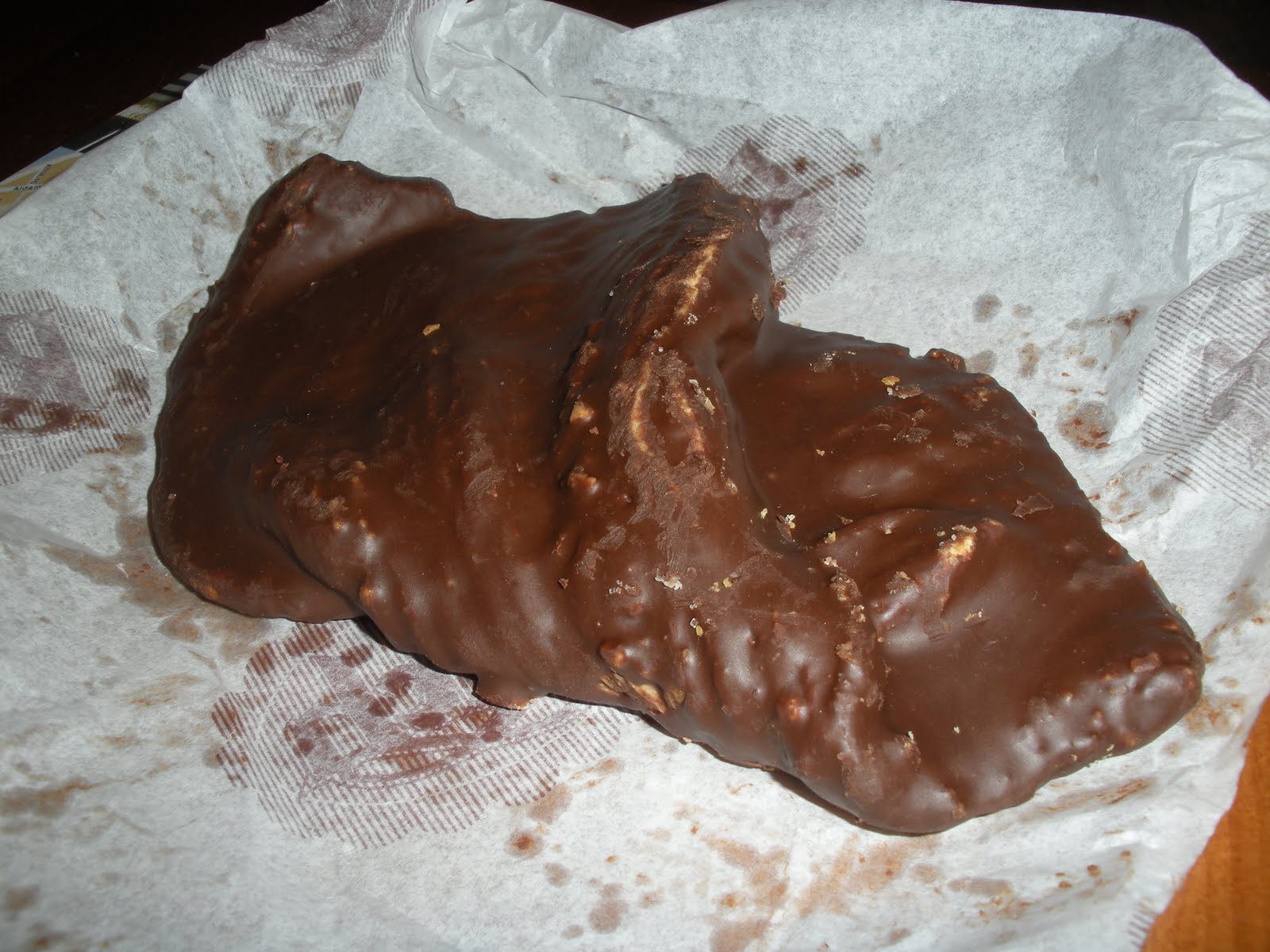
This was a pastry kind of like a palmier - a crunchy croissant, not too sweet,
but completely covered in chocolate.

Detail of pastry above.

Chocolate mousse cake.
Basque cream-filled tart... the center is pretty much the same flavor as the exteriorb
but a slightly softer texture.I wasn't crazy about it, but it was interesting to try.

This was literally a chocolate truffel on a cookie. What a fantastic idea!!


This was an amazingly delicious "fruit cake" - this is what all fruit cake should be like...
the cake was moist and sweet, the fruit was carmelized and probably soaked in
some kind of liqueur, and the top was decorated wtih slices of actual apples.

Not sure that these jellies are a particular Basque specialty, but they were incredibly delicious -
with actual fruit flavor and so very cute.


Pintxos are the way to go in Spainish Basque, but in France, the specialty is Ttoro – a seafood stew. It has some similarities with bouillibase, but a richer, stewier broth. The one we had was loaded with shrimp, prawns, white fish, and mussels, along with red peppers and tomatoes.


This seafood stew with shrimp, prawns, and crawfish-like guys, along with lots of white fish
filet, mussels, potatoes, and red peppers is a specialty in Saint Jean-de-Luz.

Grilled sardines with salade. If you approach cafefully, the bones pull out pretty easily in
one complete skeleton, and these little guys are really tasty, especially with all the herbs.


Had to include this shot of the "leftovers" from our Basque seafood stew...
These French macarons weren't nearly as pretty as the ones you'll find all over Paris, and they
weren't filled with a soft center, but they had the most delectable nutty flavor, and crisp exterior
with chewy middles. They are supposedly baked according to the same recipe used to make
them for Louis XIV when he was here for his wedding to Marie Therese in 1660.


There were some other local specialties that we did not get to try, such as piperade (peppers, tomatoes, garlic, ham, and eggs), axoa (veal or lamb stew on mashed potatoes), the herbal liquor izarra, and txakoli sparkling wine. We did have some local white wine, cidre, and sangria though to wash down all the other treats. We didn’t so much as run out of time, but run out of stretch in our pants!

Go to Basque Country – either the French side or the Spanish side, but better yet, BOTH – and go hungry, then try as many different items as you can. Things that you don’t think look good or that you don’t think you like will taste amazingly delicious because they are so fresh, and so unique, and prepared following generations of tradition.

Sunday, June 19, 2011

Loire Valley: Chinon – our favorite meal

We only spent one day in the Loire Valley, in the town of Chinon on the Rive Verielle, but this is where we had our favorite meal so far. Chinon is a small town, and we arrived at 8:45; our hotelier told us that we would have to hurry out if we wanted dinner, because places will be closing or already closed. The place she sent us to because she thought they would still be open was closed, so we continued to wander down the alleys of the Vieux Cite and came across Le Gandoyau. Their chalk-written menu outside their courtyard had items listed with “Terroir” next them, which I took to mean local specialties, so we went in. The waiter was very welcoming, (though we noticed a less-than-pleased glance between the waiter and the chef when the kitchen saw us being led to our table at 9:05 p.m.)

We ordered the two main courses that specified “terroir” along with a bottle of Chinon A.O.C. wine. One was described as “filet mignon” of Pork, and came with “noisettes” of mixed vegetables, prunes, and a delicate amount of rich, fruity sauce. The noisettes were a texture somewhat like mashed potatoes, and somewhat like polenta. I don’t really know if they contained cornmeal – French don’t typically use corn in people food as it is considered animal feed, so it could have been all potato, or a mix of other things I didn’t know. They also had shredded carrots and petit peas and were absolutely delicious. The prunes were stewed in the glaze that accompanied the pork, and were soft and sweet and tangy. It was an amazing combination, and a completely artful presentation.


Pork medallians with prunes in sauce, and "noisettes" of mixed vegetables.


The other dish was a “Tarte Sandra” which was copious amounts of the most incredible, light, crispy, buttery puff pastry imaginable, wrapped in a ginourmous pouf around a delectable, thick white fish that was smothered in fresh herbs (primarily dill) and a light and smooth cream sauce with carrots and peas. It sounds like it would be ridiculously rich, but somehow the textures were so melt-in the-mouth delicious that it didn’t taste over-the-top at all. It was absolutely delightful. In spite of the very high quality of ingredients and preparation, what really made this meal so outstanding was to have a meal prepared in precisely the region where they originated, being the freshest and most authentic of local foods.


Monday, June 13, 2011

Normandy and Brittany: Butter, Apples, and Crepes

Onward in our travels from Paris to the Breton coast (Brittany) we tried some more local specialty pastries: Far Breton is a custard cake with prunes, Kouign Amann is a fresh butter pastry, as well as a butter cookie. There are all kinds of butter biscuit around Breton and they come in all shapes and sizes. The Far Breton was probably the most unique in that the custard is firm enough to be sliced into wedges, and the figs were soaked in brandy and gave the whole the thing a deep flavor that was really unusual. The chewy figs against the creamy but firm custard was also a unique texture combination. The Kouign Amann was very similar to a croissant in layers of soft pastry dough with a crispy exterior, but it was also lightly glazed with a carmelized sugar to give it just a bit extra sweetness.


Far Breton: custard cake with Prunes

Breton butter cookie

Kouign Amann, croissant-like butter pastry was carmelized sugar glaze.

Cross-section detail of the Kouign Amann and butter cookie.


We tried a lot of crepes (pronounced creh-puh, as opposed to “crapes”). In Breton, they are basically a daily part of the diet, and are typical on-the-go street food… a emporter. Galettes refer to buckwheat crepes which are filled with savory fillings. One was filled just with cheese, and grated into the hot crepe crisped around the edges like a parmesan cracker, but was soft and melted in the middle. Another was stuffed with carmelized onions, jambon - rough cut pork pieces, emmenthal cheese, and topped with a soft-cooked fried egg – very classic. Our favorite was a fantastic combination of comte cheese inside the crepe with a topping of hard-cider-marinated chicken pieces and mixed greens and tomatoes. (Sadly, we were so hungry when we got that one, we forgot to get a photo before it was consumed. We also didn't realize how delicious it was going to be that it required recording for the blog!)


Crepe with miel et noix honey and walnuts (background) and buckwheat crepe with cheese (foreground).

Crepes are white flour and generally have sweet fillings, though they can be savory as well. We had one which was simply apricot jam, and another topped with honey and toasted walnuts. My favorite is white sugar and fresh lemon juice – much better than it sounds like such simple ingredients could be. In Normandy, there are also galichots which I believe are still a buckwheat batter, but cooked more like a pancake – thicker and not stuffed or folded, just served with the toppings. One was almost like a pizza, spread with a tomato-based sauce and topped with melted cheese and served with salad, another spread with a carmelized onion jam and topped with goose pate.

Galichot - Norman buckwheat pancake with toppings of pickels and goose rillettes.

Galichot with tomato sauce, comte cheese and anchovies.


Hard apple and pear cider cidre is the beverage of choice all around Normandy and Breton. They are stronger than most beer, but still pretty light and refreshing, with just a bit of sparkle. They come in both dry sec and sweet doux versions. We tried both from the local on-tap versions, and didn’t notice huge differences, although there were some. There are also bottled cidre, but we tried to stick with what was on tap. They had a more fermented flavor that what we’ve experienced in bottled ciders at home, but we found them thirst-quenching and the appropriate beverage to go with our other snacks de terroir – of the region. In this area, all the cider we saw was served in a wide-brimmed mug, which we also saw for sale in many of the gift shops. Some mugs had tea-cup style handles, but others, like in my picture, hand no handle.

Hard apple cider in une bolee - the traditional mug for cidre.

Friday, June 10, 2011

Treats in Paris

I know Paris is full of fantastic restaurants. It is also full of a lot of not-so-good restaurants; while Brasseries and cafes line sidewalks with tempting bistro tables for people-watching, most of these tables are filled with people drinking and smoking. Very few people are eating. Our experience at some of these places when we were tired and just needed a rest stop is that the food is “fine” but never “good” and definitely never “interesting.” And since we choose not to use our travel budget at high-end restaurants, our favorite way to truly experience fabulous French food is by stopping for treats at specialty stores like the boulangerie (bread bakery), patisserie (pastries), charcuterie (meats), fromagerie (cheeses), and confisseur/chocolatier (candies and chocolates), and the street markets for fresh produce. There is truly nothing like a fresh baguette. Unlike much of what we find in the states, with a dry crust and airy crumb, my favorite baguettes in France have a crisp crust but are so tender that even the butt ends can be simply bit into as you walk out of the store. I like the “traditionelle” which is not “French bread” (the light, white bread) but a denser, richer bread made with part whole wheat. Baguettes are also the perfect low-budget standby. While we can easily spend $20 just trying tastes of two cheeses, a baguette big enough to share with leftovers is only about $1.50.

We have tried 3 cheese so far, and sadly, I don’t know the names of any of them, but I don’t think we could get them in the States anyway. Walking into a fromagerie you will find shelves and shelves of cheese, but not a refrigerator in sight. The large blocks and wheels are simply wrapped in plastic wrap. The shops we went into offered cheeses from all over France, Holland, Switzerland, Spain, and Italy. First we tried two which I know were both from France and both cow’s milk, but I don’t know specifically what region. When we were in the Loire Valley, we tried a local cheese; apparently the only cheese they make there are chevre (a soft, spreadable cheese made from goat’s milk.) The one we tried, on the recommendation of the clerk as her favorite, had an ashy-grey exterior but otherwise a fresh grassy taste with just a hint of earthiness from the mold.


Cow's milk cheeses.

Goat's milk cheese from Loire.
The pastries are an endless source of indecision for me and Will. I try to not have more than the equivalent of one whole pastry a day, and they can be expensive (both economically and calorically!!). Will always wants the fruit based options, where I would prefer chocolate. In fact, we have yet to try and chocolate pastries this trip, mostly because they seem they would travel even less well and be even messier than the fruit ones, and we are usually getting it to go so we can enjoy it in a park somewhere. (There is never anywhere to sit in the bakeries.) On our first day, he had his sights set on a strawberry tart. It was the most impractical choice, but he was delighted by it. It was a work of art, for sure. (As is the way it is wrapped for travel – it is packaged into a seemingly delicate little tent, which actually has quite a bit of structure based on how the paper is folded and tucked around it, and adds the extra delightful element of feeling like you are opening a present when you go to unwrap and eat it!)
 

Tented, gift-wrapped strawberry tart, during the anticipation of unwrapping.

Unveiled strawberry tart from one of our favorite Parisian bakeriesm, Gosslein.

Each component was completely delicious: a buttery cookie crust, which magically refused to get soggy by the creamy, silky smooth custard filling, and all topped with perfectly ripened fresh strawberries in just the right amount of jelly glaze to make them sparkle like jewels. It is a picture of elegance and sophistication. But go to bite this thing and the elegance is all over. There is no way to eat this and look sophisticated. And actually, I do have to offer a slight bit of criticism, because while each of these parts on their own would make for a delicious dessert: cookies, custard, fresh ripe fruit, in this case they didn’t add a lot to the other components. The textures that made them so good on their own caused them to not really mesh with the others – the custard sort of slips across your tongue off the cookie, and the berries do the same. It is also difficult to cut or bite a mouthful that has a good ratio of each of the ingredients to the others. So, make of that what you will. And enjoy the lovely photo of the pre-consumed version.

This apricot tart was another of Will’s choices… nothing about it makes me want to rush to eat it. True, my photo is not the most flattering, but really it didn’t look much different in real life. However, tasting it is a completely different affair… tart and juicy fruit balanced with sweetened jelly filling and a pastry crust that is delicate without flaking all apart into a mess made for a much more easily consumed treat. These components – because they held together better and were in better proportion to each other – made for a much better pastry in my opinion.

Apicot tart.

Macarons (pronounced mah-ca-rohn with even emphasis on each syllable and distinct and separate from macaroons, the shredded coconut cookies many Americans think of) are a typically French pastry and found in bright and pastel colors in fancy structural displays all around Paris. Each color corresponds to a flavor, but basic varieties are vanilla, chocolate, coffee, pistachio, raspberry. They are basically two meringues baked into precise domed rounds and sandwiched around a thin layer of similarly flavored filling – usually just enough to bind the two cookies together and provide an extra intensity of the flavor without a huge texture difference (to give a cake-related analogy, it’s like glazing a cake to give it extra flavor and moistness, instead of frosting it to give it a completely separate texture and form.) We didn’t actually try any macarons this trip, because we tested many different ones when we were in Paris last year, and there’s so many new things to try.
Macarons in multiple flavors;

For a day when we had a couple of other activities already planned in the Marais, I checked out the New York Times recommendations for that neighborhood. They sent us to a falafel stand, Mi-Va-Mi, and neighboring Jewish bakery, Florence Finkelstein, from the most outrageously delicious sandwich we could have imagined. These fluffy, fresh, warm, and giant pitas were smeared with hummus then positively stuffed with ping-pong ball sized deep fried falafels bright green with fresh cilantro, packed with shredded white and red cabbage, slivered cucumbers, chopped tomatoes, and then topped with the creamiest marinated eggplant, a mild but flavorful roasted red pepper relish, and a house-seasoned tahini dressing. Oh MY! All that for only 5Euros (~$7.50) is surely the best deal in Paris. Will tried the sharwarma which is basically the same sandwich components but with grilled rotisserie meats instead of falafel.

Falafel sandwich, with falafel and eggplant on the left, and lots of roasted red-pepper sauce.
Shawarma sandwich.

We actually made two bakery stops, one at the recommended for apple streudel. To me, this was the most boring square blob of fruit pastry I could imagine. But as I’ve often found with the best desserts (including many of the ones I made myself!) the plainest looking can be saving all their charm for the tastebuds. The struedel had two fairly thin and soft but buttery top and bottom crusts sandwiching a delectably sweet and lightly cinnamon apply filling. The apples were shredded, sliced, and diced to gie it a really dense texture, and I think they were probably stewed before being packed into the pastry and baked. At the other more Arabic bakery, we got a crescent-shaped butter cookie coated in powdered sugar, and a semolina flour pastry stuffed with a date. It was in a honey glaze that brought out the sweetness of the date and added a delectable moistness to the rough texture of semolina dough.
Apple streudel from Florence Finkelstein's in the Marias.
Semolina cake stuffed with a date, and glazed with honey.

At the farmer’s market, we picked up some cherries and some radishes which we saw in markets ALL over France, but which I had never seen at home; they have a highly decorative red and white two-toned coloration with an oblong shape. I also snagged myself a ridged tomato that I ate at our picnic out of my hand like an apple, with just a little salt. We didn’t actually buy any white asparagus from the market, but we ate it in Amsterdam and Brussels, and saw it in markets there too, so I wanted to include a photo. They are huge around, and a bit stubbier than most green asparagus sold.

Radishes, with some cherries.
Tomato with vertical ridges.


White asparagus in farmers market, with green asparagus visible behind as comparison.


All of the restaurants we’ve been in in Europe ask if you want coffee after your dessert. I’m not sure why they are not served together, except as a way to prolong a meal experience and promote extra inter-personal interaction. So it seems that coffee is quite a part of the culture. Nevertheless, it was not always great coffee, and some of the cappuccinos Will ordered came out of a one-button push machine instead of an actual espresso maker. However, this was one of the better cups of coffee he had, and makes it onto the blog for its decidedly artful presentation.

Cappucino from a creperie near our flat in the 5eme.

Like I said earlier, while some of the top restaurants in the world can be found in Paris, that is not true for travellers in our budget. So rather than seek out mediocre examples of fine French food every night, we also enjoy taking advantage of the fact that Paris is a bustling international metropolis, with people – and therefore foods – from all over the world. Just blocks from our flat were choices of Indian, Indonesian, and Tibetan restaurants. We selected a tiny Tibetan restaurant and after I’d selected the noodle dish that I wanted (stir-fried with vegetables), we asked the server for her recommendation. She promptly directed us to the “marmite” which I have no idea to what that word refers, but there were vegetable, chicken, and pork varieties, which include sauce and vegetables served sizzling and bubbling in an individual crock. It can be accompanied by rice, but the server suggested instead that we have their house-made bread, which I think was made from rice flour and twisted into a cinnamon bun shape. It was soft and spongy and may have been steamed for part of its cooking, but it was not like a dumpling… it was definitely baked in an oven and more breadlike. It had a magical quality of being able to sop up all the brothy sauce from the marmite without becoming soggy.
Tibetan chicken "marmite" stew.

Homemade rice flour bread to accompany the marmite;
my photo doesn't make it look very good, but it was
interesting, delicious, unique, and the
perfect accompaniment.

We also had some good French restaurant experiences as well, particularly at a restaurant on the border between the 3eme and 4eme Arrondissments, called Page 35. It has a nice decorated interior with about 8 tables, but we sat at one of the tiny, awkward, metal bistro tables on the sidewalk where we could enjoy the lovely early summer evening situated directly across a mostly quiet street from a park. We only ordered plats (main dishes – in French, entrée refers to the appetizer course) because this happened to be the same day as we’d earlier consumed the ginormous falafels and shawarmas. Will ordered duck confit which came with a fresh salade verte and roasted potatoes with a hearty garnish of roasted garlic. I had the special of the day, a cod filet served on a sparkling bed of fresh greens lightly dressed in olive oil and balsamic, with gorgeous tomatoes and a basil gazpacho. The gazpacho was served in a shot glass to be poured over the whole plate before eating. It was such an artful arrangement, clever presentation, and really delightful set of bright fresh flavors, and I was thoroughly impressed.
Cod with green salad, blanched tomatoes,
and basil gazpacho (to pour over all.)


Wednesday, June 1, 2011

Eating in Belgium

What I want my photos to be of here are simply the miles of display cases full of gorgeous hand made truffles, chocolates, confections, and pastries. But as you all know, my photography sucks, my camera is ineffective and capturing images through glass, and I feel awkward, rude, typically American, and possibly inappropriate if I walk into a shop where one piece of chocolate can cost over $5 and try and take snapshots. There is no way I can describe (or even imagine, without actually seeing them!) how stunningly gorgeous and creative so many of these chocolates and desserts are. Literally my first mission upon arrival in Belgium was to get my lips on some chocolates... we had some delicious pastry in Amsterdam, but I was still feeling particularly dessert deprived. I know that will not be a problem while we are in the chocolate capital of the world!

Next for me because it was first for Will was Belgian beers. I have definitely developed a strong appreciation for Belgian and Belgian-style beers.

What is fun about being in a huge metropolis like Brussels - and especially Brussels, as a world banking center and headquarters for the European Union - is how international the food scene is as well. While mussels and frites are supposed to be a Belgian specialty (in addition to chocolate and beer of course!) we have in just a few neighborhoods passed more Lebanese restaurants than I think exist in all of Seattle. In Amsterdam, there were Argentinian and Indonesian restaurants in proportions that far-outweighed what I would have expected, often times multiple establishments all on the same street. Our first night in Brussels we visited a Bulgarian restaurant: Kocharata, in Saint-Gilles neighborhood. The cuisine influences were strongly aligned with what we recognize as Greek - moussaka, shish kebab, phyllo, as well as it's own versions of other traditional Eastern European dishes like Goulash and Borscht.

We started off with an order of the borscht, which came with a phyllo and egg pastry pictured below, very much like an omelette layered between phyllo. The borscht was amazing, and packed with all kinds of interesting ingredients. You can see in the photo how deep red the tomato broth is, but when stirred with the spoon, there was a creamy base beneath. I'm not sure if it had some dairy in it or if the red was just the beef fat raising to the top, but even if the description sounds undesireable, it was delicious. The soup was filled with tender hunks of stewed beef, spaghetti noodles, potatoes, cabbage, tomatoes, celery, cabbage, carrots, and lots and lots of herbs.

Bulgarian borscht (top) and phyllo/egg appetizer (bottom.)
Borscht
I first ordered the moussaka as my main course, but they were out for the day, so the waiter suggested another of his "favorites" - unfortunately, I can not remember what it was called. But it was a lamb, pea, potato, and okra casserole baked in an individual (well, enough for two!) serving dish topped with a thin layer of egg to finish the top. It was very well seasoned with herbs and spices. The other main we tried was the goulash, which was stewed beef and onions in a thick, rich sauce served over rice.

Bulgarian goulash and lamb and pea casserole. In the upper
right you can see the condiment dish of the spice and salt blend.

Another night we tried Lebanese food at the restaurant less than a block from our apartment, Mont Liban. We didn't realize until afterward that it is highly regarded. I ordered a sample of a cheese stuffed puff pastry, and a spinach stuffed pastry appetizer. Then stuffed grape leaves (essentially what in Greek cuisine would be dolmades) with an herbed, lemon, and rice filling and what as called mousakaa and described as an eggplant and garbanzo bean dish. I was expecting a dip, but it was much more of a vegetable dish and it was fantastic. Beautiful pieces of eggplant and whole garbanzo beans in a tomato-based seasoned sauce, served room temperature. I'm not sure if it is supposed to be eaten with a fork, like a salad or a side dish, but I spooned it into pita bread. We also had kafta, which was ground meat formed into sausage-like logs cooked in a very spicy tomato and onion sauce, garnished with lots of parsley and toasted pine nuts.

Appetizer of spinach (top) and cheese (bottom) pastry.

Stuffed grape leaves.


Mousakaa

Kefta (ground meat formed in logs) in a spicy tomato/onion sauce.


Our third night for dinner, we tried O Restaurant. It offers an a la carte menu, but the recommendations are to go with the yeux fermes (eyes closed, meaning they won't tell you what's on it until after you order it) Chef's menu. It comes with 3, 4, or 5 courses, and with or without paired wines. It was an excellent value at 25E for the 3-course menu, and we were very pleased. We first received an amuse bouche of frothed asparagus soup. I think it may have been white asparagus, or a mix of white and green, because the color was very pale, but that also could have been because it was foamed, or because of the additional dollop of creme fraiche on the top. Either way, it was excellent. But we have seen so much white asaparagus in the farmer's markets that I was anxious to try it.

Foamed asparagus soup.


The entree course was veal sliced so thin it was almost transparent. I honestly don't know for sure what the preparation was, but I believe it was cured because of what seemed to be a dark and perhaps seasoned edge, but the slices were so thin it was difficult to tell. It was served under a dark sauce that I would have thought was peppery because of the color and the grainy texture of the spices in it, but it was very mild and not at all peppery. The server told us the word in French, but she was unable to translate it, and I didn't recognize it enough to be able to look it up later. It was also garnished with chopped fresh tomatoes and a delightfully dressed mixed greens salad.

Veal.

The second course was lamb in a lamb and tomato reduction with roasted tomatoes and roasted potatoes. There were also the blissful white asparagus, which were so incredibly buttery they almost didn't have an asparagus flavor at all. I suspect that they are prized for their more mild flavor and their softer consistency, but I also expect that this particularly buttery preparation may have made these chunks of spears an even more delectable experience. The dark line along the rigth top edge of the plate was a fresh rosemary olive oil, that provided the perfect complement to each of these components by simply dragging the tines of the fork through first before stabbing a mouthful.

Lamb with tomato, potato, and white asparagus.
Finally, for dessert was a scoop of vanilla ice cream in a strawberry "soup" - I'm sure there is a much more charming French word for this preparation, but that is how the server translated it. As you can see, it's not a compote or a sauce. But the strawberries were definitely stewed in the broth, and I detected some light, fruity wine notes in the liquid. The biscuit was flavored with fresh mint and some type of crunch that I think was a seed rather than a nut. The whole texture was of crisp carmelized sugar but with a much brighter flavor than being just sweet.
Ice cream in strawberry soup with mint cookie garnish.
Near the touristy Grand Place, where there are still some high end shops mixed in with the more knick-knacky souvenier places, we stopped for some handmade nougat. We selected the pistachio variety. It is sweet without burning the back of your throat, and has a delicious nuttiness and soft meringue-y texture that melts in your mouth.
Detail of pistachio nougat.
The slice that we purchased ended up being quite a bit more expensive than we were expecting, so we thought we were done with "treats" for this area of town and this time of our day. Then we happened past Rose de Damas Oriental Pastries.

Rose de Damas Oriental Pastries, near Grand Place in Brussels.
You MUST go here.

The window displays were magnificent. We were completely enraptured and not at all craving sweets or treats but were nevertheless allured in by the call of the East and her honey-sweeted nut-laden breath of crispy, crackling ,sticky-oozing delights. The owner of the shop was busy with other customers when we walked in, and I could tell he was spending a great deal of time giving them directions. I started to get a bit frustrated while we were waiting to buy something they were trying to get concierge trip planning. However, when they were satisfied, he ended up spending almost 30 minutes talking to us about his family, how he got into the business, the pastries, how he learned the techniques, and his world travels. He was fascinating, kind, incredibly knowledgeable, and we walked out with an entire box full of pastries, instead of just a taste or two. My favorites of the 7 different ones we tried were the pistachio bird's next and the deep fried sesame (not pictured.)
Pistachio bird's nest

Fig spiral.
Deep fried flour dough with orange flavor and honey glaze. I found this recipe for these after the fact.

We didn't try this one, but it is pastry with a pistachio filling.
We tried a similar one that was yellow pastry (same flavor,
just different coloring) stuffed with a walnut filling and shaped like
a log. It was delicious, but not quite as pretty as the above with the
perforated and crimped-edge pastry.