Friday, July 22, 2011

Tuscan Treasures

By the time we got to Tuscany, it had become very easy to find good food. Not necessarily fancy, or even especially unique, but always good. I love pasta any day of the week, so to be where pasta is supposed to be a daily menu item was like heaven. And given that it is usually quite affordable, it became a go-to order for us.
One night in Florence, we ordered canneloni Florentine, which I've always
understood to be a stuffed pasta shell, so we were surprised when it was
more of a crepe, filled with a spinach stuffing and baked in a white sauce.

Osso buco, a traditional dish from Milan, was still delicious when
we had it in Florence as a secondi after the canneloni above.

Roasted rabbit.

This wasn't dinner, in fact, we didn't even actually buy any of this, but I love cheese,
and love seeing these gigantic wheels of delectable parmesagiano reggiano.
 For our last evening in Florence, we selected a casual restaurant which our guidebook described as having a "typical Florentine elegance." I don't usually think of casual and elegant in the same sentence, though it's not unheard of. Simple but delicious fresh food in Tuscany certainly meets the criteria though! So we splurged and both ordered a first and second course. We were stuffed (doggie bags are a no-no) but I was glad we were able to try each of these dishes, and overlooking the shear quantity of food, our choices were otherwise well-balanced as a meal and with each other. I started with the salad of the day: tuna and white-beans, which had a few greens and ample white onions dressed in a lemon and olive oil vinaigrette. The tuna was gorgeous, and a portion larger than what I even would have served for a main dish, but is a bit hidden by the beans in the photo below.

Tuna and white bean salad.
Will started with the pasta of the day,  which was loaded with fresh zucchini and tomatoes. What was so interesting about this is how many of the ingredients were the same as the pasta I ordered, but because of the drastically different shape of the pasta, how different both dishes tasted from each other. The shape of the pasta absolutely interacts different with the sauce, insofar as how much gets in your mouth at one time, and how the liquidy and chunky ingredients are balanced. The mouthfeel of the different shapes and textures of pasta - ridged, smooth, etc. - also play a huge role, so these two pasta dishes made for a fun experiement. We didn't realize how similar the ingredients were when we ordered them, but were glad to do the taste testing on the different pasta.

Stewed tomato and zucchini sauce on rigatoni.

Fresh tomato and zucchini sauce take on entirely different properties
when served over wide, thin, smooth noodles.

Pork scallopini with spinach. My favorite new condiment is balsamic vinegar,
especially on any kind of cooked vegetables. Popeye would be so proud to see us
slurping up this dressed spinach!!


We'd been toting around a bottle of San Gimignano Vernaccia wine for 2 days and finally decided to crack into it over lunch in the lovely park in Cortona at the edge of town which looks out over the mountain side and down to the lake the next valley over. The light, cool white wine was perfect for a mid-day refresher, and this awesome artichoke focaccia filled with tomatoes, fresh mozerrella, and argula made for a memorable picnic.


We we needed another pick-me-up that afternoon after hiking up to the mountain tops and around the backside of the hill on which Cortona rests, we ordered an Aperol Spritzer and "Tuscan Night" cocktail from the most reknowned bartender in Tuscany. Italians don't really drink alcohol without food, so there will always be at least a bowl of olives or crackers served with your drinks. If you order food from the menu, you often miss out on whatever snack they serve, and this bar made a really awesome plate of cold canapes that came with our drinks during happy hour.
The Aperol spritz (above left) is SO refreshing - a dash of sweetened Aperol liquer
which is a mild bitters (and has the bright red color) is topped off with prosecco or
another sparkling white wine and garnished with orange. The canapes consisted of toasts
with cheese and vegetables, crostini with mushroom-onion ragu, and a rolled and sliced omlette.

Can you read the sign? It says Mandorlato, specialty of the house: Marzipan, almonds, sugar, orange, citron. It was a dense (and rather dry) fruitcake, that I was disappointed to not care for at all.

Ricciarelli are cookies we saw all over Tuscany, and made much more delicious with a dip in chocolate, but are a soft yummy cookie made with marzipan which gives them a tender texture and subtle almond flavor.

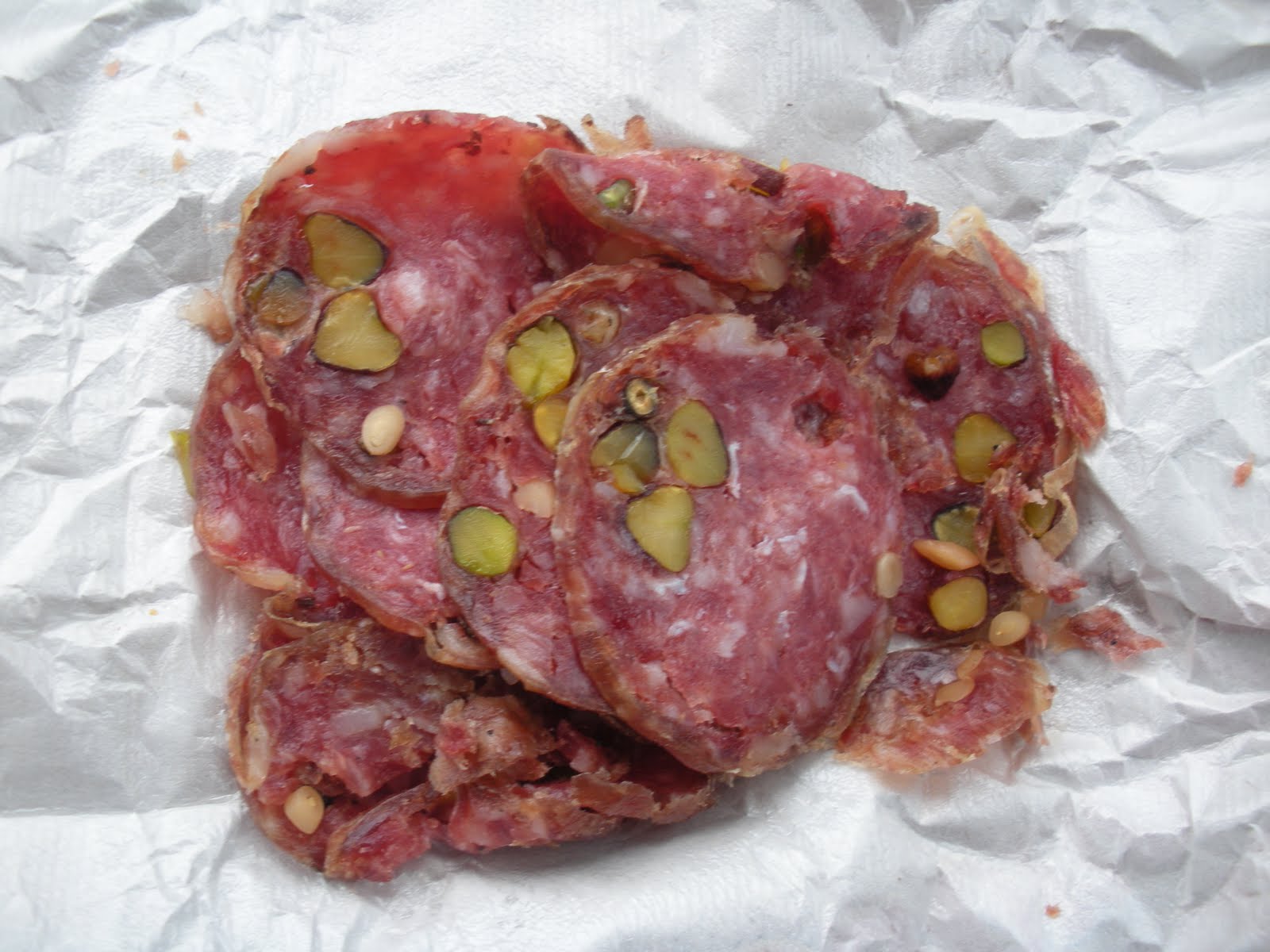
Cingale is wild boar and they use it everywhere in Tuscany. I'm not a huge sausage fan
(actually I try to avoid it as much as possible) but Will loves it, and this was one of many
we tried throughout the trip. It was my favorite, incorporating pistachios and pine nuts
into the mix, and without too much overpowering garlic.
A giant mortadella (I think they are all this size, but it was the biggest sausage I'd ever seen) which
comes from Bologna, but we saw this one in a shop in Rome.

Ribollita is a classic peasant stew with thousands of different recipes to fit a particular cook
or their garden. It is vegetables and beans with leftover bread stirred in to give it a thick,
hearty texture. I'm disappointed at how unappetizing this photo makes it look because while
it's not supposed to be glamourous, it is really delicious.

Wild boar again, this time as pasta sauce. I have no idea how they made this rich, saucy sauce without a tomato base.


The best ravioli from the entire trip, in Cortona. These freshly made pockets were filled with mild
ground beef and those gorgeous shavings all over the top are truffles. I'm not sure I've had truffles
before - at least not ones this good, and in this generous of a quantity. The entire dish was outstanding.

Trieste - Meeting of Three Empires

Treiste is known for its unique inter-melded culture due to the significant influences of Italian (Venetian), Slovenian, and Austrio-Hungarian presences throughout its history. Geographically, it is located along a large bay at the Northernmost tip of the Adriatic Sea, and right on the border with neighboring Slovenia to the East, Austria to the North, and basically as far East as you get can in Italy. The food similarly reflects these influences, with lots of seafood, but also lots of stewed meats and sauerkraut and Viennese pastries.

We had selected to visit Trieste specifically for the food. It is known throughout Italy and beyond for not only their fine foods and wines, but for the care they take in pairing the right great food with the right great wine. So, while we were nervous in selecting our first restaurant whatfor to ensure we would have a good experience, we were also pretty excited that we couldn’t go too far wrong.

The restaurant we chose based on various reviews ended up not having a particularly interesting or unusual menu. So we were pleased when we asked about the special fresh catch of the day, and the waitress became rather more excited and telling us how special it was. We had no qualms about ordering it (it was only available for a minimum of two people, so we didn’t get to “share” anything else) and her wine recommendation of a white Malvasia from the Fruili-Venezia-Guilia.


She told us the special, and even though she spoke quite good English, she didn’t know how to translate the specific main ingredient, so after her amusing but only slightly useful hand gestures, we could only guess that it was some type of shellfish. Another table next to use was shortly thereafter served two servings of a lobster dish, so we were pretty sure that was what we were getting, but I couldn’t have been happier when our meal came out as crab! The word is granchio and the specific variety was grana sporetta. It was served over a large macaroni with a tomato, oregano, and chive sauce and it was completely fantastic. The wine was not one we had heard of before, but it really did complement the meal well. It was light and mineral, with a fair amount of fruitiness without being sweet.

For dessert, Will tried their panne cotta with chocolate sauce. We were very pleased with our Adriatic catch-of-the-day!
The next day we went in a completely different direction, far away from the sea and straight into the Austrian empire. The New York Times only has one restaurant recommendation for Trieste, so that’s where we headed… Buffet della Pepi (buffet doesn’t mean what it typically means in the U.S.) We ordered the all-meats selection with some body parts on it we don’t usually see on menus, and certainly don’t think to eat at home. I can’t say I enjoyed all of them, but I absolutely appreciated the opportunity to try them in a venue where they are known to be specialties. I did however love the caraway-heavy saukerkraut, thick moist caraway bread, and tangy mustard accompaniments. I don’t think I’m going to try for “head” or “tongue” again anytime soon, but it was fun for a day and you’ve gotta love their cheeky serving platter.
Can you read this menu? I had to try very hard to not let it scare me off,
but I wanted to eat like a local...

The 'buffet' - the serving plate is worth the price of admission.

Finally, the area is well-known for their pastries, and I consumed many. Most went into my mouth much quicker than it was possible to photograph them…. Linzer torte, ricotta cheese cake, croissants stuffed with raspberry jam or custard (because croissants aren’t rich enough unless you add a filling?), soft egg bread studded with chocolate chips and rolled around a chocolate-hazelnut filling, and of course struedels of all types, but especially apple. One of the favorite shapes is a pretzel, and you see breads, pastries, and cookies all wrapped into a pretzel round. The one we tried is filled with almonds, hazelnuts, figs, rum, and ameretto cooked into a thick paste stuffing.


My last word about Trieste actually applies much more broadly to all the areas of France and Italy we have travelled. That is that gelato (which actually means any kind of ice cream, even a pre-packaged paper wrapped ice cream cone, not just the high-quality, smooth, flavor-intense gourmet products we think of as gelato at home) – which we have sampled extensively! – has reflected the locale specialties in each region by the special flavors offered. We had chestnut flavor in Paris, calisson in Aix, and “opera” in Verona (a cream-flavored base with toffee hazelnuts and chocolate shavings.) In Trieste, we had Black Forest (chocolate with cherries) and Sacher (chocolate with apricot). What a great way to interpret cuisine! What flavor would Seattle be? (Coffee doesn’t count…)

Pasta and Panzarotti in Verona

Verona has a huge opera festival every summer which draw attendees from around the world. This is a lovely town to visit with some neat Roman ruins, interesting medieval and Renaissance history and architecture, and a significant river running around the edge of old town. However, we might not have made time for this stop if it hadn’t been for wanting to see an opera in an ancient Roman arena.

Since the town is flooded with opera-goers almost every evening for months, the city could easily “get away with” being a tourist town. But we really got the sense that this was an authentic Italian city in spite of all the foreign tourists. We were in a bit of a rush to get through dinner in time to get seats in the unreserved section of the arena, so we couldn’t linger over our meal the way we typically would try to do as Italians. And the restaurant our guidebook recommended didn’t open for dinner until too late for us to have time to eat, so we had to continue down the road a piece to an unknown venue. Nevertheless, I suspect that we would have had a great meal anywhere, because Verona just seemed like a place where the people cared about what they make and serve.

Again, in the name of time, we opted for pasta dishes, but both were excellent. Will’s wasn’t particularly photogenic, being simple tortellini with butter and sage, but it was delectable. Mine was not only delicious, but it was completely unique from what I have seen on other menus so far. Many of the pastas – being served in Italy as a primi (first course) instead of as a main dish, are simple (but delicious and thoughtful!) preparations of specific pasta shapes paired with a complementary sauce. However, the dish I ordered came with multiple additional ingredients – common for my own style of preparing pasta at home, but unlike what I have experienced yet in Italy. The pasta was called bigoli and were hand-rolled thick spaghetti-like noodles. The sauce was rich with eggplant, cooked down into a creamy coating, along with red peppers, pine nuts, raisins, and thick shavings of parmesangio.


For lunch the next day, we stopped for panzarotti. They are basically a calzone, except the dough is more breadlike as opposed to a pizza crust. They were delicious. The place we bought them served only these, along with a few foccacias and some risotto balls (also delicious!) They came in all different kinds of dough, as you can see by the colors in the photo. I ordered one in a plain pastry with a spinach, ricotta, and mozzerella filling. Will’s dough was speckled with olives and hot peppers, and stuffed with spicy salami, tomato sauce, and cheeses. They make for the perfect lunch, and even last in the backpack long enough for an afternoon top-off snack!

All the panzarottis lined up in the shop window. So many choices!

Mine was a plain dough stuffed with mozarella and spinach.
Will's was an olive and tomato dough stuffed with spicy meat and cheese.

We also sampled a risotto fritter.

Tuesday, July 19, 2011

Italy!

We have been so excited to get to Italy for months now… the pastas! The gelato! The wine! The cheese! The tomatoes! The fill-in-the-blank-delicious-things-to-eat-and-drink!

Our first stop was Cinque Terre, on the Italian Riviera. Some of the cuisine here is similar to what we were already getting exposed to in the French Riviera because, after all, Nice (on the French Riviera) used to be part of Italy. Pastas and seafood are a great way to go here. Focaccia is from this region too, making for great snacks and sandwiches. 
Foccacia with tomatoes, pesto, and fresh mozzarella. Others of my favorite
toppings include carmelized onions, or artichokes.
For our first meal in Liguria, we were in Monterosso al Mer, one of the five towns of the Cinque Terre at Ristorante Via Venti. We had a seafood ravioli in a seafood sauce… the raviolis were comprised of a white sheet of pasta and a dark sheet of pasta (typically dyed with squid ink, which doesn’t really add much in the way of flavor but makes the sheets an attractive contrast) stuffed with a white fish filling and served in a sauce with shreds of squid and flakes of fish. The other dish was house-made gnocchi in a crab sauce. The gnocchi were the perfect tender consistency, but of a much more substantial texture – almost grainy like cornmeal but without the crunch of any grain. The crab in the sauce was shredded so finely that I almost at first thought it was cheese, but it gave the dish a very light and of-the-sea aroma that paired nicely with the creamy potato dumplings.
 

Crab gnocchi from Via Venti.

Seafood ravioli - we loved how the two sheets of the ravioli were made from different pastas
- one traditional plain, and the other squid ink.
                                                                                                                                                            
For snacks, we ate lots of gelato which was all made fresh daily at each place we selected, and so much less expensive than anywhere in France. We tried flavors from pineapple and mango, to “ambrosia” which was hazelnuts and chocolate in a cream base, and tiramisu.

Focacceria is our new favorite boulangerie. Focaccia is from Liguria (the Northwestern sea-side region of Italy) and a focacceria bakes it fresh with various toppings. Standard is just olive oil and salt, but more substantial versions can include onions, or olives, or tomatoes, or the version we tried had pesto and cheese for a great late-morning snack. It also makes great sandwiches when stuffed with meats, cheeses, or vegetables and grilled in a Panini press.

One thing I saw that I didn’t get to try was a lovely tart topped with figs, walnuts, and marcona almonds. I would love to try to recreate it at home. It also looked like it may have been glazed with honey. How about trying that with a lightly sweetened ricotta filling?!?

We tried two beverage specialties of the region, an orange version of limoncello made locally in cinqueterre, as well as sciacchetra, a wine made in this region from a particular kind of grape that has aged almost to raisin stage, giving it a very ripe, sweet, and pungent flavor that I can only describe as being close to port. It is quite expensive, because the grapes must be aged before the wine can be made, thus requiring more grapes to produce the same quantity of wine. All sciacchetra are made from the same type of grape, but other wise can vary just like any other wine based on the age, the vineyard where the grapes were grown, the winemaker, etc. Because it is so sweet and strong compared to other wine (it is about 18% alcohol instead of about 11%) it is served in 2-ounce cordial glasses as a digestivo – an after-dinner drink. We tried two versions – a cheap one and a more expensive one ($8 and $12) and noticed a significant difference in favor of the higher-priced variety.
Orange liqueur, made like limoncello but with arancia.
Our two glasses of sciacchetra, the slightly darker one on the left was the more expensive variety.
Both were the same age, but it had a smoother, less alcoholy flavor. It is traditional for this wine,
as with vin santo, to be served with a cookie. In this case, almond biscottis.


Saturday, July 16, 2011

Seafood from the Mediterranean: Cassis and Villefrache-sur-Mer

Cassis is a low-key beach resort on the Mediterranean, and Villefranche-sur-Mer is down the coast a couple of hours, just East of the large seaport of Nice. All the foods of this region are dominated by seafood, and there is significant Italian influence as well, as much of this area was once under the control of Italy, so pastas and pizzas can also feature heavily.

One night for dinner, we had moules Provencal, mussels cooked in a butter, garlic and herb sauce, as well as sea bass in a rich red bell pepper cream sauce, and prawns in an Herbes de Provence (generally chervil, marjoram, tarragon, basil, thyme, and sometimes lavender) butter rub. 


Salade Nicoise is another popular standby, and can take many forms, though generally includes a bed of greens topped with green beans, tomatoes, olives, hard boiled egg, and lots of tuna. Every bistro makes it’s own twist to this classic tuna salad from Nice, and we also saw these primary ingredients take many other forms than just salad, such as sandwiches, pastas, and my new favorite, pizza Nicoise!

Salade Nicoise, with lettuce, cucumbers, tomatoes, hard boiled egg, olives, anchovies, and lots of
delicious fresh tuna. I am used to seeing Nicoise salade with potatoes and green beans, and that did
not seem to be a feature for the ones I ordered, but I think those ingredients were not seasonal,
and the salades probably vary with what is fresh.
My new favorite version of "Nicoise" - on a pizza! This one was heavy with
tuna, olives, red bell peppers, red onion, parsley, and anchovies.
The pizza above came from a very enjoyable restaurant in Villefranche-sur-Mer, La Grignotiere where we were also stuffed with this amazing spaghetti below. We could have shared either one of these two dishes and still both been too full for dessert, but they were so good that we were glad to have ordered two items to try. The spaghetti was topped with boatloads of just-caught prawns and mussels.


Friday, July 8, 2011

Languedoc: Cassolet in Carcassonne, Pastis en Provence, and Calissons d’Aix

Languedoc is the region of Southern France which is West of Provence. A specialty near Carcassonne is cassolet, and we dined in the old city at the top of a hill on an outdoor patio with the closest view being of the fortress, and behind that the Cathedral dating from the 400’s. I’m not sure if it was the best cassolet in town, but given the setting, it tasted pretty delicious.
Cassoulet with duck from Carcassonne.
From there, we were just a short train ride into Provence, where we spent time in Arles, Nimes, Avignon, and Aix-en-Provence. Our guidebook discussed a “gastronomic dining experience” at the restaurant of famous chef Jean-Luc Rabanel. Fortunately for our wallets, his expensive ($150/person) put-your-meal-in-the-hands-of-the-chef restaurant was closed both nights we stayed in Arles. However, his also recommended bistro A Cote next door was open where the 4-course dinner was 37E.

I ordered a seafood main which included a filet of white fish cooked in a single-serve paella-style pan with lots of mild, roasted garlic, carrots, mussels, and a prawn.


Will ordered the fois gros starter, lamb with potatoes and vegetables, the cheese plate which had three lovely selections – one local, and both others from France – a camembert and a goat cheese.


Everything was very delicious. I didn’t find it especially “experimental” like the guidebook had described it, except for possibly the dessert, which was awesome.  It was a layer of chestnut mousse topped with a “fromage blanc” (which our waitress described as “yogurt.” I would have called it “crème fraiche.”) That layer was then topped with a baked layer of carmelized tart sweet apricots. The combination of flavors and the thick creamy but slightly grainy texture of the chestnut mousse was outstanding.

In any case, it was fun to know we were experiencing the work of a renowned chef.

The untouched dessert, as presented in its ramekin. With such lovely layering of the custards,
I was surprised it wasn't served in a clear serving dish to highlight the contrasts.

After we scooped below the top layer of apricots - see the cream topping with the chestnut mousse on the spoon!
In Aix-en-Provence, we made a potentially risky choice of a near-empty restaurant with a nice-looking menu but prices that seemed “too good to be true.” We know when things seem that way, they often are, and we were nervous that our budget-consciousness would leave us disappointed with our meal. But we were in for such a treat! The menu was specifically called out as “specialities d’Aix” – items and preparations unique not just to Provence, but to Aix in particular. We each had a 3-course meal, so between the two of us, we sampled 6 different dishes, starting with salads. 

The two salads were basically the same base of fresh mixed greens, tomatoes, and a balsamic vinaigrette. One was topped with lots of tiny cubes of three different cheeses and the other topped with squid. I was boldy and bravely venturing for nearly the first time into squid territory (because of my positive experiences on this trip with octopus). Concerns about chewiness be gone! This squid were the silkiest, most tender salad toppings I could imagine. They were stewed in a flavorful broth, then served warm on a crisp bed of fresh salad greens and dressed with tomatoes and vinaigrette.


Salad with cheeses.

Salad with squid.


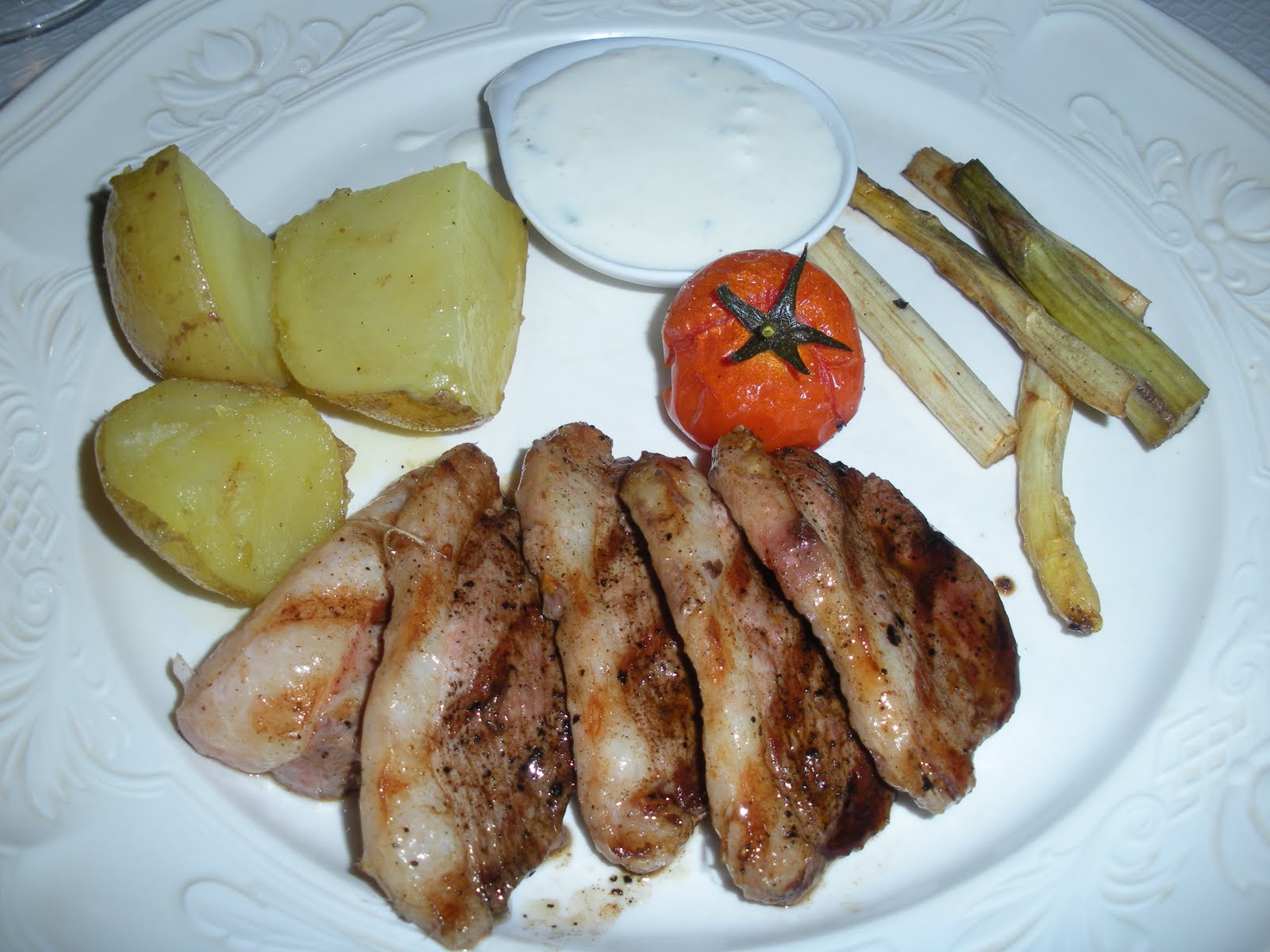
After that, we had a tenderized flank steak with an onion-cherry confit, and a duck breast with a yogurt-cheese sauce.
Duck.

Steak.
For dessert, we had a delicious stacked 3-chocolate mousse cake: three layers of chocolate - milk and hazelnut praline, white, and dark mousse on a thin butter pastry with crème anglaise. But the coup-de-grace was a Calisson Cream dessert of the house. Calisson is the name of a specialty confection from Aix. It is a thin, almost papery wafer, topped by a ground-almond paste similar to marizpan, and frosted with a thin layer of a sweet but otherwise rather tasteless frosting which hardens into a crust (sometimes, that is then covered in chocolate, which definitely improves the whole thing!) They are formed into an almond shape about 2 inches across. The overall effect is of a subtle flavored, slightly sticky but mostly smooth and not too sweet candy. If you don't like marzipan, you might not like these, and the wafer on the bottom that gives it all structure can be a bit off putting, primarily by its rice-paper texture. But they are unique, and enjoyable,and used in many different forms, like liqueur, gelato, and cookies. In this case, the chef used the ground almonds and almond flavoring in a whipped cream, which filled a yummy waffle-cone cup lined with chocolate - not at all rice-papery, but still waffle imprinted like the candy base.
Triple chocolate mousse cake.

Calisson confections interpreted as a dessert.

Actual calissons in their expected form from the confectionary.